
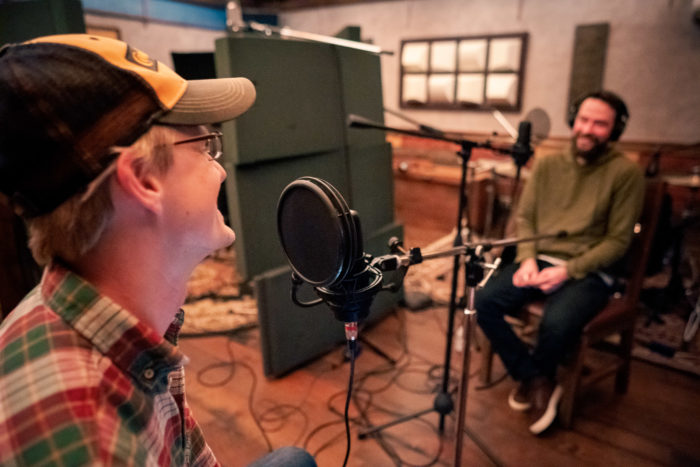
Justus and Michael discuss the motivations and reasoning behind launching the Porchlight Art and Hospitality Network. They then explain the qualities and virtues they hope to draw together and further cultivate in the network. Stay tuned at the end to hear a live rendition of “Face to Face,” by the Local Hang-Ups.
This is The Spirit of the Porchlight Network, Episode 47 of the Renew the Arts Podcast.
Welcome to the Renew the Arts Podcast, where we discuss the role of art and creativity in the church and in the world. We’re your hosts, Michael Minkoff and Justice Stump. Our mission at Renew the Arts is to cultivate Christian communities in and through the arts by inspiring art patronage and supporting artists.
You may notice this is a new mission for us. More on that in a moment. If you’d like to contribute to our work in art sponsorship or collaborative community, there are a number of ways you can do that.
You can become a host on the Porchlight Network by visiting Porchlight.art and clicking Interested in Hosting. You could also join our patron community today on Patreon. It’s really easy and it starts at a dollar a month.
Go to patreon.com/renew the Arts to learn more.
It’s been a while since we’ve had a podcast, and I am very sorry, personally, very sorry about that. It is almost entirely my fault. Like, actually almost entirely my fault.
But we’ve also been really, really busy, and we got a lot of exciting things to talk to you about today, and I’ve got Justus with me, and we’re gonna do things a bit differently, because Porchlight, which you may or may not have heard of, I hope you have heard of it, or we’re not doing a very good job on messaging. But if you haven’t heard of it, it is an arts and hospitality network that we just launched this last year, and it’s had a lot of growth and just been exploding, actually. Almost overwhelmingly, it’s one of those things where it’s like the biggest problem that we have right now is our own success, which is great, and also-
New for us. Yeah, very new for us. Okay, so today I wanted to talk a little bit about Porchlight.
A couple of things. First, how it came to be, and it’s pretty much Justus’ brainchild, so I’m going to be picking his brain as if I don’t know what’s in there. And-
You don’t know me.
Hopefully get something out of it that’s interesting. And then after that, we’re going to talk a little bit about the spirit that we want to cultivate in Porchlight, both with the artists and with the hosts. And so first, a little background about how we got around to the Porchlight picture, which started as a vision pivot.
And so tell us a little bit about like what happened, like what were the problems that were generating these questions and these reconsiderations on our part.
Right. So before we even necessarily decided to launch Porchlight, like you said, we were kind of shifting gears at Renew the Arts. And yeah, there was a really critical time and it was kind of a short amount of time where several things happened all at once.
I remember I was on the way, I was on a flight from Atlanta to LA where I was attending a Praxis Labs event, which is an organization I highly recommend. It’s basically a collective of Christian entrepreneurs and mentors and all kinds of stuff. It’s really great.
You can look them up online. Andy Crouch is one of their mentors and does a lot of content for them. But anyway, I was flying out for a five-day conference experience and on the flight out, I read Donald Miller’s Story Brand, which is a marketing book.
It helps you articulate your vision. But what was interesting enough is that it accomplished a very different thing for me. I was reading it and I realized that I had kind of misjudged who the hero was in the story of the arts and Renew the Arts and the artists that we were working with and our donors and everything like that.
And I realized that by kind of placing ourselves as by placing Renew the Arts as kind of the entity that had to save the day, we took all the burden, I guess, responsibility and even the joy out of real people stepping in and helping in tangible ways in artists’ lives. And that wasn’t going to really work in the long term. And I was trying to figure out, historically speaking and moving forward, what would it look like for people to help artists?
I know that that sounds like a really basic question, but it was a very important one. And then I attended Praxis and it was a phenomenal reorient for me to realize that our primary audience should probably actually not be artists, even though they’re the ones we want to serve. Our primary audience was probably going to be the donors and especially patrons that could help the artists because if we could inspire them, then the work of supporting artists would be relatively easy.
Right. But when you first brought this idea back to me and were like, I think we really need to seriously pivot toward patronage, like focusing on patronage, a little part of me resisted that because I was like, our whole point here is to serve the artists, the artists are underserved. But we started thinking about it together, and one of the major issues for the artists that we ran into over and over and over and over again, is that we were releasing their work into a void.
Right.
So it was like, we could do these great projects, and we would put the money and the man hours and the elbow grease into making them happen, then we would release them, and there was no audience, which was almost worse than not even having the art made in some ways. I mean, it’s not.
Yeah, yeah, yeah.
The artists appreciated it, but at the same time, it’s such a disappointment to work so hard on something and then release it, and it’s like…
Crickets.
Yeah, nothing. And so by focusing on patronage, there’s this solution to that problem, which actually ends up serving the artists. And so the other issue that we were having was that, well, we had the two frames.
So we had to sponsor creation and cultivating conversation. And we were doing a good job of making art, lots of projects, we worked on everything. And I think we were doing a pretty good job of trying to have conversations.
But I felt like, and I mean, you can confirm or deny, but I felt like we were reaching a brick wall in terms of at least the leadership of the church being willing to, I don’t know, help us, work with us, et cetera. There was a lot of suspicion about it. And what we found over and over and over again, is that we would go in particular church environments, and the congregation would be like, what you’re saying fills a deep need in my heart, and it feels so right, and I think that you guys are correct.
We talked to pastors at the same churches, and the pastor would be like, hold your horses now. How is this gonna change things? And it was very uncomfortable for them to contemplate that much change in the way that they were approaching things.
And there’s lots that could be said about that, but we were like, what if we just engaged these church members directly?
There’s definitely an element of that. I think that even more importantly was realizing we wanted to change people without serving them.
You mean before?
Before. Yeah, previously. So this idea of like whether it’s a church pastor or even just people in the congregation, there was this idea that the church approaches art in a wrong way, which is true in a large part.
And so we had these things to fix. And in that way, you actually have an audience of people you’re trying to change.
Which means that they’re not going to want to hear what you have to say. And honestly, that’s-
Yeah, I mean, who wants to be approached in that way?
I would, but what I found is that the way that I appreciate being approached and the straightforwardness of that, whatever, and just get to the point-ness of it, I’m not, that’s my, I am the problem here.
A little, a little bit, a little bit, yes, but also, and I know this from being your friend for a long time, that even then, you like direct communication, but it’s built on trust that someone is trying to serve you. And I don’t think we had that organizationally or interpersonally. We wanted to change a lot of people without establishing a relationship of service with them.
Meaning, so we had, we served artists. Yes, this was the paradigm. We’re here to serve artists.
You need to figure it out and help us serve artists. You need to change so that we can better serve artists.
Exactly. You’re the obstacle. And yeah, and you pointed that out with the video, the Meet Micah video.
The part of it that really annoys you at this point is the end where it’s like, help us, help them.
Right. And in marketing terms with the whole story brand thing, that’s making us the hero.
Right.
Instead of them. But in a really real way, that’s reflective of, I think, a proud posture on my part.
Well, I don’t know about yours. I think I will claim that.
Either way.
It’s mine.
On our part, it was a proud posture where we wanted to change people without first asking how we could serve them. And so if our audience, since the artists are already doing what they should be doing, let’s just assume, and what we really need is to step in and support them, then what really needs to happen? You need to develop a community of support.
And if that’s your primary goal or your primary audience, if that’s what your main job to do is in your hopes of serving artists is to create this community of support, then approaching them just with change, so that you can help these other people over here, instead of us saying, we’re here to serve you and your felt needs, right? And change will occur, but this is modeled after Jesus. How did Jesus change people?
He served them. He was incredibly humble. He became the lowest and washed the disciples’ feet.
And so this idea of, and I think that this is actually a toxic way of approaching change in almost every sector right now, where it’s most simple to try to force people into the change you want to see. But the messier and more difficult, but ultimately far more productive way of changing people, is by serving them. And it helps them become open to change, but even more importantly, it makes you open to realizing what they actually need, right?
And what this whole situation actually needs. And it’s been interesting that as we’ve committed to this pivot, I realized that I wasn’t thinking deeply about the role of anyone but the artists in the church, and how they interact with the arts. One of the huge revelations was, if it’s true that the arts are profound and can bring a huge amount of value to your life, and there are people out there, whether they’re donors or patrons or just audience members, and this kind of depth of experience is missing from their lives, why does my heart not want to introduce them to these experiences that will enrich their life?
Like invite them into that wonderful experience.
I was hoping they would just support us so we could go help artists. I wasn’t realizing the way in which they were underserved, and trying to figure out how to use our tools and our relationships with musicians and artists, and all of the knowledge that we have about the importance of the arts, and the enrichment that it can bring to your life, and bringing that to them to serve them with. So once I started noticing that and realizing, oh man, our posture towards the audience members and donors, and patrons and everyone else but the artists basically, our posture towards these people is one of not caring.
And so what would it look like if we figured out how to care for them? And that really got me thinking about trying to pivot, because even strategically speaking, if we could capture that audience, if we could really resonate with that audience, then our job of serving musicians and artists down the road becomes basically a matter of fact.
Yeah, for sure. And so with that in mind, we immediately started working on a new mission and vision and giving it to the board. And at the risk of this kind of bogging down in technical ease or whatnot, I do want to talk a little bit about the mission and vision that we came to.
You heard it at the beginning of the podcast. We haven’t abandoned the idea that Christian creativity should be liberated. But liberate Christian creativity is in some ways a motto or a call to arms or something like that.
It’s not, it wasn’t giving us a specific enough goal that we were trying to reach. And so we came up with what we believe to be a more modest and simple and probably achievable or at least, you know, short-term achievable goal. And that is with the mission is to cultivate Christian communities in and through the arts by inspiring art patronage and supporting artists, which is pretty straightforward.
But the real focus of it is that idea of cultivating Christian communities. And in some ways, rather than us becoming the middlemen that try and keep people on the one side or the other, or at least effectively do whether we meant to or not, actually bring them together and try to create a partnership, a collaborative partnership, and have that more of as a spirit of what we’re trying to do. And the new vision is to see patrons and artists partner, there you go, in communities to create art that enriches our lives, shapes our homes and helps us love our neighbors.
And a lot of that language and a lot of that thought came from this idea that that we’ve just been talking about, that we see a lot of division, we see a lot of self-centeredness, in ourselves, in the arts, in everywhere. And how do we break through that and actually get back to really the Christ-centered way of just focusing on service? How can you serve other people and give yourself to them and actually achieve influence through that rather than coercion, rather than manipulation, but actually seek for influence and persuasion through service and self-giving?
And that’s really Jesus’ way. And you see it all throughout. So that’s what we’re trying to work on.
As always, let us know if we’re doing a poor job. But that’s where we’re trying to be right now. And so I want to talk a little bit, if it’s all right, about the spirit that we want to cultivate in Porchlight.
And before that, tell me, Justus, why does Porchlight uniquely satisfy the needs that we’ve been talking about and sort of the goals of our mission and vision?
Yeah. Well, in the mission statement, you almost hear a little bit of the strategy where it’s cultivating Christian communities in and through the arts by inspiring art patronage and supporting artists. So you have these three elements, community, patronage and support.
And I think that if you are able to develop experiences that people gather around that are profound enough and that serve them enough, and that goes to the mission or the vision statement where it talks about profound and enriching or the kind of art that helps us love our neighbors. If you are able to cultivate those kind of experiences with the arts, then hopefully a result of that will be patronage. And of course, an obvious result of patronage well, it’s in itself is that support of the artists.
And it becomes kind of a feedback loop because once artists are supported, then they create art which communities gather around. So as far as how Porchlight specifically plays into it, so you have this vision and a huge chunk of it is inspiring patronage. Like how do we get the church or the people of the church, how do we get believers to become patrons again?
The church used to actually do this quite a lot, the church corporate but also the individuals within the church. It used to be a very common thing as Christians to commission pieces of art that served the city and serve the community. That has fallen out of practice and it’s an easy thing to say, hey, we’re going to make new patrons of the arts.
It’s a very difficult thing. I was met with a lot of skepticism when I was shopping this around. But it’s a very different thing to actually do it.
It’s like, okay, sure, new patrons of the arts, everyone wants that. That sounds great. How do you actually do that?
Where are they? Where are the people that would even become that if they’re not even it right now? So where are the candidates of people who would move into that role?
And maybe people have been searching wrong for that because maybe they’re doing their global wealth finder and trying to figure out who the richest people in their communities are and stuff like that. And so they’re like, hey, you’re a rich person, you could be a patron of the arts. And that’s the only way that we’re really thinking about it.
Well, there are all kinds of motivations for becoming, you know, for seeking someone out to be a patron or even for being a patron. A lot of times it’s built around hierarchies of cool, you know, like social hierarchies, even status, you know, yeah, creating status. There are all kinds of ways.
We’re not totally interested in all of that. In fact, we’d rather eschew that.
Totally, really partially.
No, no, we’d rather eschew those approaches to the arts. What we’re really looking for whenever we think of an ideal patron as someone who’s truly generous and genuine and in legitimate relationships with artists and has a collaborative spirit towards the arts and is able to help either financially or in other ways.
This seems like an ideal time to interrupt and thank profusely some of our new patrons on Patreon who are long overdue for a shout out. Thank you, thank you, thank you to Eric Swanson, Hope Newman Kemp, Jordan Davis, Brian Dean, Kevin Drendel and Austin Smith. Thank you so very much for your patience and for your support.
To all of our Patreon supporters and cheerleaders, thank you so much for being in this with us. If you want to help us make this podcast, serve patrons and support the arts, you can join us on patreon.com/renew the Arts.
I don’t know, I guess we have one of our fundamental assumptions is that you can’t convince someone to be an art patron by talking them into it. I remember whenever I talked to people about this pivot, they said, oh, so you’re like an educational organization, like you’re here to educate people into becoming patrons, like patronage 101. And right off the bat, I knew that wasn’t going to happen.
I’ve been to so many-
Well, we’ve been doing it for 10 years and not been able to get a half of you.
Exactly, and not just us. I’ve seen tons of like-minded organizations, like-minded people, philosophers, artists, professors, influencers who have been taking that approach, podcasts, blogs, articles, books, lectures, conferences. All of it, all the didactic, all the teaching type, lecture type method.
And there’s a strange irony where these people who are trying to accomplish know the power of embodied truth and they know the formative power of beauty, but then when they’re trying to actually convince someone of that, they fall into lecture.
Propositions and lecture.
They fall into propositions. And it’s like, wait, I thought you knew better. It’s like, if you want someone to become a patron, give them an experience.
Like you and I care about art, not because we came to some conclusion reading a book somewhere, but because of the profound effect that certain art had in our lives. And that made us, that developed a habit in us to find those deep wells of meaning and of truth and of beauty that actually made our lives more worth living. And so you can’t just talk someone into that.
It’s like food. No one asked for a recipe before they’ve tasted the food. You know what I mean?
Like have you ever just described a recipe and someone’s like, can I, can you, can you, or described a dish and say, okay, can you give me that recipe? It’s always you serve someone, you invite someone into an experience with the food, they eat it, and then maybe there’s some didactic type propositional.
Right. Explanations and maybe some like reviews, because everybody likes to confirm that the thing that they just tasted was in fact good and to talk about why it was so good.
But it starts with the experience.
It does. Even biblically speaking, there’s lots of different experientially oriented, like the idea of taste and see that God is good. Right.
It’s not like there is a lot of hear, hear and listen, obviously, but there’s also taste and see. There’s a sense in which the goodness of God has to be experienced in order for it to be believed. In some ways, I think that is part of what works about Porchlight.
Because we did 50 shows this last season, and we’re going to do a bunch more this season, we hope. You had all of these people who gave so much and so freely, and at the end of it, felt like they had been the ones who received the blessing. It is true.
If Jesus says it is more blessed to give than to receive, if the spirit of the church actually believed that, like if the church actually believed that, then we would all be fumbling over each other, competing with each other, trying to give. Like, no, I’ll give, you know. And what a different kind of environment that would be.
And so…
It sounds so foreign, but literally, I hear stories like that from the Porchlight hosts and artists all the time. Where it’s like, this host was amazing, like they took such care of me. And then the musician would say, right?
And then the host would be like, that musician was incredible, they just brought us. And it’s like, so thoughtful, so considerate. Yeah, it’s like, wait a second.
Right. So, if you can’t talk someone into patronage, they have to experience, you have to invite them into an experience that kind of turns the light switch on. And so, it was like, okay, so that’s a good, I think, whether we’re right or wrong, we believe that and that’s our assumption moving forward.
So, what kind of experiences are unique and profound enough to move someone from just being, having like a consumeristic mindset toward art to having an incredibly profound experience so that they’re moved into relationship with the art, hopefully with the artist too, because relationship with artists is a big part of patronage, in such a way that they would, you know, move into that role of patronage. So, after chewing on that for a while, one really great option was house shows, especially when it comes to music. So, there are different options and we actually hope eventually to expand into other media, but since music is our wheelhouse, we’re just, you know, we’re gonna stick with music for the, you know, to launch and to figure, you know, work out the kinks.
So, in the context of music, we thought that house shows are the best option of cultivating those kind of unique, profound relational experiences that might move either the host or audience members or the community in general into a different posture towards the arts, which might include eventually patronage.
Well, and in a sense, the idea that hospitality is patronage.
Totally, exactly. So those hosts in some, you know, yeah.
They’re already patronage.
Exactly.
Yeah. And so that was an important thing too. And we’ll talk about that a little bit.
In fact, we’re going to talk about it right now.
Great transition.
After this word from our sponsors.
That after this. And now.
And now. So let’s talk about the spirit we want to cultivate in Porchlight among the hosts and the artists. I have it written here, hosts first.
But, and it’s a good segue from what we were just talking about. So we have three things that we want to see hosts committed to. And so this is both things we’re looking for in hosts on the Porchlight Network, but also things that we’re wanting to cultivate, grow, water, nurture within the spirit of the organization because it’s important to us.
And you know, you can’t be asking for something and then fighting against it systemically at the same time and expect for the results to be what you’re purportedly asking for. And so this is a spirit we’re also trying to cultivate in ourselves as well. So we want to see hosts committed to one, hospitality, two, growth and three, relationship.
Those are our three things that we have been thinking a lot about. And in terms of hospitality, we’re talking about radical generosity and openness. So tell us how the Porchlight Network helps with or is oriented around this radical generosity and openness.
Well, yeah. So once we figured out that house shows was a great way to do it, then came the question of how do we actually structure it and stuff. And one of the very first, early on, it became one of the questions was, is this a network where people can host shows and get a cut of the income?
Which is not a necessarily…
Nothing immoral about it.
No, there’s no wrong way of doing that. Or excuse me, there’s nothing inherently wrong in doing it that way.
Because there’s definitely wrong ways of doing that.
There is a wrong way of doing that. And we’ve heard terrible stories of house shows where the host was mainly just doing it as a side hustle.
And ended up cutting out all the artists in the end in order to get their minimum. And so the artist came and played, he got nothing so that the host could get the money.
Yeah, we don’t want to create a structure that incentivizes that kind of action. So early on, we made the decision that even though it was a tall order, that hosts wouldn’t get a cut, even though they totally deserve it. But what’s interesting is that that brings hosts who are doing this out of hospitality, a heart for hospitality, a heart for generosity.
It’s like, well, what do hosts get out of it? It’s like, you tell me, man. You know what I mean?
I’ve been asked that so many times. So wait, what are the hosts getting out of this? It’s like, why would you host a party?
Why does anyone host anything? You know what I mean? It’s almost like this goodness in their own hearts gets satisfaction in putting this kind of thing on.
Satisfaction enough to keep doing it just because.
Well, and I mean, if you talk to the hosts, which we have interviews and stuff from them and then-
Oh yeah.
Yeah. So I mean, you can check it out. They’ll all talk about the profound experiences that they’re having, even in just the experience of the art and surrounding it in preparing for the artists, having opportunities to, I mean, most of them have dinner with the artists before shows.
Oftentimes, artists are staying in their houses and then leaving the next day, or in a guest area or whatever. So you have the opportunity to talk, to spend time, to actually get personally engaged with these extremely creative and interesting people who then bring their highly crafted work, before you and your friends. It’s like, is that worth a little bit of time and energy and money?
Like you said, you tell me, man. The hosts have all been saying definitely yes, so that they’ll do it again and they want more.
Can we have that artist again sometime, and who else do you have? Yeah, it’s its own reward.
It is, and well, again, it’s more blessed to give than to receive, which means that there’s a certain sense in which you can learn in Christlikeness to give for the joy of what you get from giving, which is really weird, but it’s true. That’s how God is, so I’m for it. Then the other part of the hospitality is the openness.
One of the things that we’re trying to do, and this is more my side of things a little bit, because I do the artist on-boarding and meet with all the artists before hand and on Zoom and such and listen to their music and all this other kind of stuff. One of my thoughts regularly is about the hosts. I don’t necessarily want hosts to have whatever taste they currently have to just be confirmed in some kind of an echo chamber where it’s just like they just keep on, I like what I like and I keep liking what I like.
I wanna introduce them to legitimately good and well-crafted things that may be slightly on the fringes of where they’re currently at, what they could currently receive over time, so that they can learn to appreciate a broader variety of things. And that will, I believe and I hope, cultivate that sort of openness to the broader, deeper, larger realm of the arts, which is actually humongous. And so, that’s one of the things we’re working at, but we’re also looking for hosts that have openness, and in some ways, the structure of Porchlight almost requires it.
And that openness will continue to thrive as our curation is appropriate, meaning part of that openness is trust of us, saying this artist will serve you well.
Right, right.
And so, that’ll definitely be kind of a long play, where hosts will learn, if we’re successful, and if we’re good at taking care of hosts and putting their needs at the top of our priority, which is what we’ve been trying to do this whole time, like, how do we create experiences that will deeply and profoundly serve hosts?
Right.
And if the solution, or if the answer to that is, this artist and this artist, who you may not have heard of, but if you go out on a limb, and host them, you’re gonna have quite an evening.
Well, and it’s always the going out on a limb. I mean, that risk-taking is the whole part of the reward. You take that little risk, you take that little step, you open yourself up to this new experience, and then that’s when you get blown away.
Now, sometimes you get disappointed, because that’s what a risk is. But just opening yourself up to that creates the opportunity also for that reward, and it’s a much different kind of feeling and a kind of reward than you can get when you’re just staying in your comfortable lane and your complacency with that. And a lot of the hosts have been really open to that.
And a lot of the hosts will tell stories about that kind of stuff. Things didn’t work out the way we thought it was going to be like this, and then it started to rain, and we didn’t know that. So we had to go over here, and we had to ask these people for help, and we had to reach out to these people, and then they came in, and then we started working with them.
And it’s like, and then the night went out, and it was great, and it was a success, and it was like an adventure.
It was better than it would have been, because everyone was carrying chairs, and it became a group effort, which is such a perfect picture of what we’re trying to do, this idea of making culture is a group effort. And I’m tired of, I don’t know, the mindset of how it’s divided up to where you go over there and create, and then all stream it on Netflix. You know what I mean?
It’s like, that’s not a group.
Transactional.
It’s totally transactional, and physically separated, and socially separated. It’s just entirely compartmentalized. Instead of like, whenever you go to a house show, something beautiful is made because all of you were there.
Not because the artist was there, not because the host was there, not because the audience was there, but because y’all all pitched in, and it results in this resonant, harmonious event where everyone made something incredible.
Right. So, that kind of openness leads to this idea of growth, which is part of what we’re talking about as well. And one of the things that we’re working on in the network is to continue to grow the patrons and grow artists and continue to grow as a group in unity, but also in openness to hearing from one another, and that’s how this works.
The third part of it, because we kind of covered the growth and the hospitality at the same time, because they are really interconnected.
Sure, yeah, you mean like growth of taste? Yeah, yeah, yeah. So you’re right, an expanded horizon.
Right.
Totally, yeah.
Yeah, and just this like growing appreciation for the value of material goodness, which is a whole other huge conversation, but there’s a lot of abstraction and a lot of hyper-spiritualization and Gnosticism latent, and we’ve talked about that before. And so this devotion to the good of your neighbor and the good of your community, the material good, like the blessing and benefit of your neighbor, and learning the difference between really good and not really good, and actually pursuing that excellence does have evangelistic and spiritual benefits. When it hasn’t just become a rejection of God for self-pleasure, but that’s obviously not what we’re talking about.
Right. And so anyway, then beyond that, and connected to that is this idea of relationship. That third thing that we’re really trying to work with, which is we want them to commission over consuming.
So rather than being consumers separated distant from the artists, we want them to be commissioners and to develop relationships with both artists and with their neighbors. Really cool thing about Porchlight, if you want people to show up, you can ask the same people over and over again and they might end up showing up over and over again. That might happen.
But for a lot of hosts, what I’ve found being a host on Porchlight is that you can’t necessarily count on the same kinds of people being able to be there every time. You have to start to grow your pool. And I’ve got neighbors I’ve never met.
It’s just the truth, I have neighbors I’ve never met. What stops me from going over to my neighbor and saying, hey, I’m going to have a show, free food, free drinks, come on over, it’s going to be great, great artists, good music, hang out, get to know you, be awesome. And then all of a sudden, I’m developing relationships with my neighbors and my community as well.
And I’m presenting something from my own resources that is actually good for the community and potentially creating avenues through which the truth can do its work. And so like that, that, I think, I want to see that more and more in the patrons. And again, the network actually drives that kind of relationship.
You have to, you’re going to develop relationships with the artists in your communities and other hosts in your area and Christians across the country and all this other kind of stuff. It’s just there. It’s just what happens.
It’s just happening.
Yeah.
There’s almost no way to not.
Yeah. Right. All right.
So that’s kind of a wrap up on the hosts, on the spirit that we’re looking for is that openness, growth and relationship and that they’re committed to those things. And so far, I think, how many hosts do we have?
So we launched in October of 2020. So it’s been about a year and a half now and we have around 200 hosts, which is just incredible.
It really is.
Yeah.
Especially considering what we’re asking of them from the get-go. We didn’t really expect that they were just going to sign up like, oh, you want me to give freely and not receive anything materially in return, aside from an incredible spiritual experience that I don’t even know necessarily whether or not it’s valuable. It’s like, yeah, that’s what we’re looking for.
Hoping.
Yeah, and everyone was like, dig, dig, dig, sign me up. Yeah. All right.
And so artists obviously have been really interested in signing up for this because we kind of launched this accidentally around the same time where all of the conventional venues were drying up because of COVID.
Well, that definitely was part of it. Once we were thinking of this pivot and everything, and then COVID hit, we’re trying to figure out how could we best serve musicians during COVID, the house show network was this incredible overlap of those two needs, where it met our need of trying to reinvigorate patronage, but also met the need, a felt need, current need of musicians who were not able to play shows in typical venues because it’s not safe. They’re basically metal boxes, cram as many people in there as you can, and that’s just not COVID friendly.
So it was like, well, if we launch this, we could do backyard shows, right? And outdoors, socially distance, we could do, even if they’re indoors, smaller numbers, so that really drops potential transmission rates and stuff like that.
And majority of friends and family anyway.
Exactly.
You’re already around each other.
So yeah, that’s why it kind of lit a fire for us to really do it in October of 2020. And so yeah, we launched it then, have 200 hosts signed up now and counting, and musicians kind of lined up out the door and around the block.
I think we did 100 or 95 or something like that. Something like 95 or 100 artist interviews.
Yeah, that sounds about right.
And we have like 45.
I mean, just imagine on average how many shows a given musician may want to play in a year.
Yeah.
Then multiply that by 100.
Right.
It’s like, whoa, nope, slow down. But hopefully we’re able to scale so that we can have a little bit wider of a bottleneck to let more folks in.
Right. That we’ll talk about a little bit later. But first, I want to talk about what I want from my artists.
Oh, yeah.
So let’s talk about from my artists.
From your roster. You take a lot of ownership. Well, Michael is the Director of Artist Care, so you do have a lot of ownership in it.
I do. I love talking with and working with the artists. I’ve noticed some qualities that are in common with most of the artists.
Oddly, what is in common between all the artists is not necessarily the same degree of technical skill. It’s not the same style. I am pretty open even to music that I don’t necessarily like all that much, being on the network, as long as I think it’s going to serve the hosts in some way.
And as long as the artists meet these three criteria.
Okay, what are these three?
Oh, well, they are. First, humility and second, authenticity and three, service. So it’s the same kind of idea.
I’m looking for artists that are committed to these three things as a spirit. Humility is, well, for our purposes, it’s an eagerness to receive critique and grow, and it’s a willingness to persevere through setbacks. So what I’ve noticed with a lot of the artists that I talked to is I’m going, how many records have you tried to make up to this point?
You know what I mean? And it’s like, well, I haven’t gotten a deal yet, or I haven’t really been able to get out there and all this other kind of stuff. And it’s just like, no, no, man.
I know artists that have no support, that have no money, that have been making garage band recordings in their bedroom for five years just trying to get better.
Or even if it’s not records, you know what I mean? They’re out there, they’re out there, like playing shows, exactly, like doing all kinds of stuff.
I’m trying to persevere. And that’s really important to me, because I believe that in this will get to the issue of service. But a lot of times if the idea is I want to serve myself and I want to be served, well, like, I have a network full of hosts that want to serve, but I would like to protect them from people who are self-serving.
Because that’s the quickest way to destroy the network. And so I really am looking for not fake humility, actual humility, and thankfully, I’m a pretty abrasive person, which means I’m perfect for this job, because I can detect really early on, and if you think, oh, I could fake my way through it and you do not, I’m going to say something or do something, where you’re going to be like, oh, I don’t like that. And then we’ll see how you…
And then we’ll see.
Then we’ll see how you really are. And I don’t do that in any kind of a mean-spirited way. In many ways, it is just the way that God made me, which is what I was saying earlier.
Like, I like to speak straightforwardly, and I like people to speak straightforwardly to me. More than most, right? I mean, there’s a limit.
But because of that, I’m ideally suited to detect whether or not a person can actually receive feedback and critique in a productive way. And it’s pretty easy to see when a person is not that way. And it’s also pretty easy to not let them on the network.
You’re really showing people our hand.
That’s okay. That’s what I said. You can come in and think.
You can try. You can try. Gotcha.
There’s a shtick here that I like to talk about where when we call Porchlight an Art and Hospitality Network, and a lot of people hear that and think, oh, right, yeah, because the musicians make the art and the hosts provide the hospitality. But that’s a fair read, granted. But on an operational level, I actually think that that’s not it.
Hosts provide hospitality, but so do the musicians. This community is only going to work if everyone has each other’s interests at heart. Because celebrity culture is basically like, how can all of this attention and money and power serve me?
And be leveraged by me to get more money and power.
Yeah. There’s this terrible thing that happened at Astroworld. Are you familiar with it?
Astroworld is apparently this giant venue. It’s like a mega venue. Can you remember where in the country it is?
But yeah, it’s Astroworld. It’s called Astroworld. And there’s this event.
It was this rapper who had this big concert. And like between six and 12 people died because the venue hadn’t properly provided enough water and enough, like, you know, all kinds of stuff. But then like, so the venue was at fault for a lot of operational and they didn’t have enough security was another one.
So there were a lot of logistics and operational. You could call them oversights. Maybe they’re a little worse than oversights.
Like, criminal negligence?
Yeah, exactly. But then, like, what the people actually died from, besides just a lot of them getting dehydrated, the ones that died, died because they were dehydrated on the crown, but then they got trampled. So like, the crowd wanted to get closer to the artist, you know, pushing toward the stage.
And the people died because they were trampled under foot, you know, by other crowd members.
So we haven’t had that many of those kind of concerts on the Porchlight Network.
Well, no, but there’s a really interesting foil here. So you have the crowd and then the venue, and then the artist actually was told, hey, stop the show, people are dying. And he kept playing.
Now this has actually happened before. People have died at concerts, it’s not totally unheard of. There are cases of accidental death and trampling where the band stops playing, it’s like, all right, settle down, everyone take a step back.
But in this case, the musician just kept playing music until like literally like the sound system shut or you know, like things shut down and the musician’s response was, everyone join me and flip, give the bird to the sky. It’s like, F, I don’t even know what.
Yeah, I mean what? This day, this circumstances?
It sucks, you know? So there’s this terrible and I don’t want it to be, this is the exact opposite of what we’re trying to do, even though it’s still music, it’s still a show, in some ways it’s the same thing, but in every real way, it’s the opposite because the musician only cares about their show. And if something’s getting in the way of the attention being on them, it leads to rage because they aren’t getting the attention and the platform that they signed up for.
Same thing for the host. The host was cutting costs, not providing enough water, not providing enough security because the well-being, exactly, the well-being of the audience and potentially of the musician was not their highest priority. This is what happens when everyone in a concert context is after their own good.
It’s like celebrity culture at its worst. And we’re trying to accomplish basically the exact opposite.
And it is interesting that that humility on the part of the artist is connected to the hospitality on the part of the patron and that there’s a sort of like mutual self-giving that happens that really makes the network work. It really wouldn’t work. I’m boggled that it does work, to be honest.
Like it’s kind of a little miracle every time these things go off.
Right.
And both parties are like giving of themselves.
Well, it is a miracle.
And I know it is a miracle.
It’s a miracle because as much as Jesus is a miracle, like he modeled a life that is so incredible and like almost impossible, impossible without the spirit. But you have this upside down world that he proposes that really does work entirely against the grain with how, you know, money and power and prestige and celebrity functions.
Right.
And I think that’s one of the reasons why, you know, it’s kind of where we have a lot of language, a lot of faith-based language. And people ask me if it’s a Christian network and it’s like, well, it’s not Christian in that like we would exclude non-Christian, like unbelieving hosts, for example, we would totally be fine if they agree to these principles of humility and hospitality. It’s like, we’re not Christian in the way, in the sense that we say we’re here and you’re there, we’re not exclusive, right?
But we are Christian in that we try as best we can to emulate the hospitality of Jesus and like the sacrifice of Jesus in serving and putting others first, right? And I think that ultimately long-term, that’s the only way that you’re actually going to achieve a community that is this collaborative and hospitable and productive. It’s, it’s, that’s the only way.
Like in some ways, not to like, I don’t tend to get unnecessarily theological, but in this practical way, the emulation of Jesus’s heart of hospitality is the only way to achieve this kind of community and network that will actually function right.
I agree with you 100 percent and it is Christ-likeness ultimately. I mean, if we, if we were to just put the spirit we want to cultivate in Porchlight in one word, it would just be like Christ-likeness. Right.
But the way that that works out in particulars is wonderful to see because it is working out. The second thing that I look for and it’s along the lines of this Christ-likeness in terms of artists is this authenticity, which we put humility first, we talked about this before the podcast because if I were to say authentic, a lot of people are like, well, that just means whatever you are, you are, and yes, but some people are genuinely, honestly, and really jerks.
My authentic me is not good all the time.
Exactly.
So I am looking for authenticity, but in some ways I want it to be subject to humility in the sense that if you are seeking yourself and you’re authentic, then your work becomes all about self-expression and you don’t actually care whether or not it is doing anything benefiting the listener or the audience. And that obviously does not contribute to a collaborative partnership in the arts or even patronage. But I am still looking for authenticity.
I’m looking for artists that are self-aware and transparent. And partly, there’s a certain courage that’s involved in that authenticity that I’m looking for because they’re not necessarily conforming themselves to the superficial external requirements of the art at large. So in some ways, this actually has a direct effect on their art.
That they’re willing to make the art that they like and that they think that they can do well. Because in some ways, if you’re like, how do I serve the world? Rather than, there’s two ways of going about it.
You can say, there are these certain needs or these certain wants of the people around me. Or you could say, well, first, let me think, what am I good at? What am I really, really gifted at?
And a lot of these artists that have this kind of authenticity, they have come to that conclusion. I’m really good at this particular kind of thing or this particular kind of music or this particular kind of writing. And it’s what I do well.
And I could try to write in a way that I don’t do well, because that’s what apparently people want. But that wouldn’t be true to what God has given me to give to the world. And so I’m going to give to the world what he’s given me, even if it’s not in high demand right this moment.
And I’m going to be confident that God will use that in the ways that he sees fit, because that’s what he gave me to give.
And there’s obviously balance there that has to happen, but that is what I’m looking for in terms of the artists that are on there. I think that there’s a whole lot too much posturing and pretense in the arts, especially in the arts within the church. And when you find those artists who are humble, and yet at the same time boldly courageous, which usually go together ironically, to do the things that God have given them, that man, those are the artists that really, I feel like, are making really solid and good and worthy things in the world right now.
The third thing is service, and it’s connected to that.
That’s totally what we just talked about.
It’s what we just talked about, because if you have this self-awareness and you have this transparency and humility together, and then you’re balancing that against this desire to give what God has given you in the service of others, in the service of these hosts, then that’s when that partnership actually develops. That’s when the art starts to actually bear fruit in the lives of others. And in some ways, you learn to hone and you learn a little bit more, like what kind of art you should be making in that particular community.
Most artists right now are making art in a void one way or the other. Even if you do have a huge audience of people, it’s not like you can go and to speak to the conglomerate of the millions of people that listen to your music on Spotify. And you’re not going to get a clear idea of what it is that they need.
You’re only going to get some semi clear idea of the things that they have in the past liked. And you can maybe say, well, in order to maintain their interest, I need to continue to make that thing. But that’s not actually necessarily even serving them.
Because again, you’re not actually contributing to their growth and their development. But if you could sit down with, you know, hosts in a whole area and have that kind of a community and actually sit down with them, talk with them, be like, where are you at right now? What is it that you need?
What would you like me to write about or to, you know, whatever about? You know, what would serve you right now? And all of a sudden you start getting commissioned and you start getting feedback and that affects the kind of art that you make in a very direct and particular way and not just in some general superficial way.
Totally.
And so that we are working for that too. And of course we want artists who are interested in that, in that process and that process of collaboration and partnership.
Cause you can talk about making art in community and that can just sound like a catchphrase or just fluff. It’s like, yeah, you know, I want to make music and have people around. But no, this is like, this means something.
It means that when you make art, sometimes it’s at the request or because of a conversation or, you know, even financially commissioned or, you know, born out of an experience that you had with these different people. So it really does mean something, very practical and generative, to be a part of this community and to create, you know, within and from this community.
So far, we’ve seen it really working well.
Yeah, it’s awesome.
It really has been amazing. And we have, like you said, 200 hosts, 45 active musicians. We have a wonderful team of volunteers that have come on.
When I say volunteers, it’s like the worst, because people are like, oh, you mean like, you know, people in college or right out of high school, you know? And it’s like, no, no, no, these are people getting like masters in art and theology and all this stuff, you know?
It’s like artists on their own right. All kinds of, yeah.
And they’re all like extremely thoughtful. I mean, they’re awesome. And then we have a new team of kind of hybrid communications people and everything.
Like we’ve gone from a team of what, three or four to about a team of 12 now.
Yeah, so I guess it would be five, six plus three, about ten, nine or ten. Okay.
Okay. And then that’s been really awesome to see that developing in that way. And just the growth, like seriously, that’s the last year.
Yeah.
The last thing is we hope to scale this even more because we have an app in the works right now. And we’re hoping that it will be rolled out. It’s a backend app.
It’s not going to be like on your iPhone or whatnot. It will just be on the Internet. But it will allow for hosts and artists to create profiles, view each other’s profiles, collate availability.
It will not affect any of the things about the network that have been great, that are personal and that require personal interaction. But it’s going to save us a lot of just the mechanical grudge.
Mechanical tedium, hopefully. Lord willing. Yeah, the way that we are planning on scaling is through that app and through the team.
All right, well, thank you all for listening and for being patient with us. I am sorry about the delay between the last podcast and this one, but I am going to be on it. I have new priorities and I’m dedicated to being a more responsible human being on this earth.
In the area of podcasts.
In the area of podcasts. And so we’re on a one per month schedule right now, and I am going to do my very best to get you one decent podcast a month.
And you’ll have help.
Yeah, I’ll have help. So, and stay tuned because we have one of our new volunteers slash employees. I don’t know, she’s kind of in a hybrid model.
But yeah, she’s going to be coming on. Her name is Abby Sidderley, and she is a journalist and a storyteller and has been really helpful in doing the host interview. So if you’ve read any of those host interview blog articles, that’s her work.
And we’re going to come and talk about that next time. So the next podcast will be me and Abby talking about intentional communities. And we’re going to talk a little bit about Lebrie and Larch and some other stuff.
That sounds awesome. Yeah. You’re not invited.
I don’t want to be. I want to listen to that.
All right.
Underqualified. So see you guys later.
Thanks.
Thanks for sticking with us.
When Justus and I were together, we didn’t discuss what song we wanted to play at the end of this podcast, but we just finished recording and mixing a live record for a band called The Local Hang-Ups, which actually happens to include Abby Sidderley. They have a song about how nice it is to play in front of people at a live audience that they did at a private Porchlight concert that we were able to record. So we’re just going to play a little bit of that concert right now.
This is a song called Face to Face by The Local Hang-Ups.
This is our fourth house show of our tour on Porchlight, which is great. I forgot to introduce us, we are the Local Hang-Ups and we’re from Rochester, New York, which is super cold right now. So we’re certainly happy to be here where it’s over 50 degrees.
We started our band in March of 2020, which was a rather uneventful year, but that’s definitely a lie. So basically we had to start our band in a time where connectivity and playing with people in the room was not allowed. So we did a lot of live streams, but we’re certainly happy to be here and to play for some actual faces.
So on that note, this is Face to Face.
Thank you for your thoughtful presentation on the Spirit of Porchlight Art. I can honestly say as much as I know you two that this is a genuine expression of who you are in your effort to slice and divide real art among an audience hungry for artistic sustenance. I am excited to see how you are maturing in your calling.
Thanks for commenting, Charlie!
That is very encouraging!